May 3, 2021

Emerging Markets In Africa: Should You Invest?

Investing in Africa

As a smart investor, you know that a diverse portfolio tends to yield the best results. Many investors stick with domestic stocks and bonds for their portfolio but branching out to emerging markets in Africa and other spots around the globe can be a profitable option for many investors.

Emerging markets and frontier markets stem from economies that are either less developed than markets in places such as the United States, Japan, and the European Union, as well as countries that simply have not historically allowed as much access to their markets.


For instance, Vietnam is an emerging market that has not yet reached first world status but is making strides toward that goal. Iceland, on the other hand, has a strong economy and high standard of living but is emerging because access to its stock and bond markets has been limited. As the focus of this article is investing in frontier and emerging markets in Africa, we will explore the following:

     Why invest in emerging market countries from Africa?

     Conducting the right research

     Learning about the country

     Analyzing the company/companies

Emerging Markets in Africa

Why should you consider emerging markets in Africa? Africa is a continent that features many emerging and frontier markets which may provide investors with some excellent financial opportunities. While these markets can be a riskier option, there is the potential for excellent long-term growth. There may be a bit more risk, but you also have the possibility of a solid return on investment.


It can be smart, in general, to mix in a few of these somewhat riskier investments along with your more conservative investments. Over time, this can yield a more substantial result. As with any investment opportunity, doing a bit of research is important, but it is especially important when you opt for investments that carry a bit of extra risk.


Conduct The Right Research

Research is crucial for any type of investing, but when it comes to emerging market investments, we recommend that you conduct the following research.


Learn About The Country

While you may be purchasing stocks or bonds from a private company or companies in Africa, it is smart to learn about the country where these companies are headquartered. Check the countrys GDP, or Gross Domestic Product, and learn a bit about the debt level of the country. Another good indicator would be taking a look at the countrys foreign reserves.


Gross Domestic Product

First, lets talk about GDP. This is simply the value of all of the goods and services a country produces during a single year. For instance, the United States had a 2019 GDP of about $21 trillion, while China had a GDP of about $14.3 trillion and Italy had about $2 trillion.


On the African continent, lets look at two nations on opposite ends of the spectrum. GDPs in Africa ranged from Nigeria, which had a GDP of about $442 billion in 2020 to countries such as Cape Verde, which has an estimated 2020 GDP of less than $2 billion. Countries with larger GDPs tend to have healthier or more robust economies therefore you might expect that an investment in Nigeria might be a safer bet than an investment in Cape Verde. 


Debt-To-GDP Ratio

A countrys debt level is another important factor to consider. We hear a lot about the debt level in the United States, which is how much money the government owes. The government spends more than it earns so in order to continue offering services, it issues bonds and treasury bills to cover these costs.


Typically, when economists talk about debt level, they are talking about a countrys (or a companys) debt-to-GDP ratio. This is simply when we compare how much a country or company earns in comparison to how much it owes. Many counties, including the United States, Japan, Italy, and Greece often owe more than they produce or close to that amount.


In general, when a country has more debt than profit, it is less likely that they will be able to pay back their debts. With countries such as the United States and Japan, this is not as much of a worry as it might be with a country such as Greece, which has a weaker economy in general.


Throughout the African continent, the debt-to-GDP ratio varies tremendously. For instance, Nigeria is estimated in 2020 to have a debt-to-GDP ratio of about 34%. Cape Verde, the other African nation we used as an example for GDP has a debt-to-GDP ratio of about 127%. When we look at the GDP and the debt, its even more clear that Nigeria has a stronger economy than Cape Verde.


Just as a reference, the United States had a debt-to-GDP ratio of about 79% in 2019, so emerging markets certainly arent the only nations with substantial debt although it may be more difficult for emerging nations to repay debt than it would for a country such as the United States.


Foreign Reserves

Countries often hold currency from other nations as well as assets such as gold to help bolster their own currency. These reserves are held by the nations central bank. In the United States, the Federal Reserve System is our central bank. In Nigeria, the central bank is simply called the Central Bank of Nigeria. In Cape Verde, the Bank of Cape Verde serves as the central bank.


In the United States, we have about $129 billion in foreign reserves while Nigeria has about $35 billion, which is the highest in Africa. Cape Verde has less than $1 billion in foreign reserves, which can make it more difficult for that government to stabilize its currency. China has the most foreign reserves of any country, with more than $3 trillion in reserves.


In general, countries with a larger foreign reserve (also called FX reserves or forex reserves) tend to have more stable economies. When you look at these types of factors, such as GDP, debt and forex, it helps you gauge the risk factor of investing in a specific nation or a company in that nation.


Look At The Company

When you buy stocks, you are purchasing a piece of a company. When you purchase bonds, you are lending a company money. Whether you purchase stocks or bonds, it is wise to look at the companys financials before you invest. We recommend that you study both the country of origin as well as the companies themselves to make the best possible financial decisions. 


If you decide to opt for a mutual fund or exchange-traded fund, which includes multiple holdings, research each of the holdings within that fund, particularly the companies that are weighted more heavily. In some cases, the weight will be distributed fairly evenly, but those top holdings tend to have the most effect on earnings and losses.


When looking at foreign companies, especially in emerging and frontier markets, its important to look at several factors. These include looking at the financial history as well as the financial projections. Looking back in time can provide you with a solid picture of the overall financial success of the company, but its certainly not the only factor.


After all, perhaps the company has had several years with poor earnings and debt acquisition, but the company principals have changed. The new management team might improve the health of the company, so it can be smart to look into the histories of some of the upper management team as well as taking a good look at the business itself and how it supports the community and the nation.


With emerging markets in Africa, you are taking a bit of a risk, but on the plus side, you have a unique opportunity to potentially grow your portfolio while also helping to improve the economy of an emerging nation. When you invest in a company such as Amazon or Google, its stable and safe but not particularly interesting, while an investment in an emerging nation can be more rewarding.


For instance, lets talk about a business near and dear to our founder, Larry Serumas heart. Feronia, which is an agribusiness operating in the Democratic Republic of the Congo (DRC), manages three palm oil plantations in the DRC, one of which was established more than a century ago.


These plantations employ thousands of people, and the palm oil produced at these plantations is sold domestically, which helps reduce the countrys reliance on imports. Additionally, Feronia provides medical support and educational resources in the communities near these plantations. This type of investment can be a solid option for anyone wanting to include socially responsible investments in their portfolio.


This is just one example of a potential emerging market investment. While we arent recommending this investment over any others, it simply showcases how your investment truly makes a positive impact on a community and a nation. Emerging market investing can be both profitable and philanthropic, provided you engage in some research about each investment.


Learn More About Africa Investing

While we might make an emotional push toward investing in emerging markets in Africa and around the world, we know that the ultimate goal of an investor is to build their wealth. Designing a balanced portfolio with many conservative investments provides you with the opportunity to also include a few potentially riskier investments, such as those in emerging and frontier markets.


To keep up-to-date with African investing news, follow our blog, Money Watch Africa. This includes insights into emerging markets in Africa as well as tips and market insights from our founder, Larry Seruma, who has been writing about investing in Africa for more than a decade. 

December 1, 2020

Frontier Markets & Investing in Africa: What You Need To Know

Frontier Markets & Investing in Africa: What You Need To Know

If you are searching for some unique investment opportunities, diving into frontier markets can be an option to consider. These markets are far less competitive than those in developed nations, but there are some risks associated with frontier market investments. 


What Are Frontier Markets?

Different index providers, such as S&P, MSCI and FTSE will classify countries as frontier markets based upon a number of factors. In general, when we talk about frontier markets, we are discussing countries that do not yet have developed markets. These nations often will have less liquidity, lower market capitalization and may still be developing a stable economy, but not always.

For instance, Iceland is considered to be a frontier market, and they have one of the highest standards of living in the world. Index providers don’t always agree as to which nations qualify as frontier markets. For instance, Kuwait is listed by MSCI as an emerging market while S&P rates it as a frontier market. Again, Kuwait also has a fairly high standard of living, so when we talk about frontier markets, we sometimes are simply talking about ease of access in terms of investing in that nation. 

There are frontier markets throughout the world including Africa, South America, Asia and Europe. In Africa, where we maintain our focus, some frontier markets include Nigeria, Kenya, Tanzania, Morocco, Ghana and the Democratic Republic of the Congo (DRC). As nations develop and more investment opportunities become available, these countries may be moved from the frontier category up to the status of an emerging market. 


How Do Frontier Markets Differ From Emerging Markets?

There are three basic market levels – Developed, Emerging and Frontier. Developed markets include nations such as the United States, Canada, the United Kingdom, France, Italy, Spain, Sweden, Australia, Japan, Singapore and others that have highly developed economies, thriving markets and easy access for investors.

Emerging markets include countries with developed economies, but they aren’t quite as accessible or stable as the developed markets. For instance, while Hong Kong is considered developed, China is listed as an emerging market. Brazil, Russia and India are three other emerging markets that are popular with investors, but there are many more, such as Argentina, Mexico, Egypt, Greece, Hungary, the UAE, Korea, Pakistan and Thailand.


Why Should An Investor Consider Frontier Markets?

In general, investments in developed countries pose the least amount of risk to investors, followed by emerging markets and then frontier markets. While frontier markets can be somewhat riskier, this doesn’t mean you should not consider investing in these markets or emerging markets. 

In some cases, higher risk leads to higher rewards. For instance, let’s say you invest your money in a tech startup. This new business is relatively untested and there’s always the possibility that the company could go under. However, if the company has some interesting products or services, the business could become a major player in the tech industry, and you can reap the rewards. It’s a higher risk, but also carries the potential of high yields that you might not see from an established player in the tech industry. 

Frontier markets provide investors to essentially dive into a nation’s economy on the ground floor. There’s little competition so you end up being one of the premier players in the region. Not only that, but you have the opportunity to invest in a nation’s future, which can be a once-in-a-lifetime opportunity to help a country realize its economic potential.

While you should never put all your eggs into one basket, so to speak, investing in frontier markets offers you the potential of higher yields than you might earn with investments in developed markets. The key to any investment opportunity is to research the investment and learn as much as you can about the company and its potential. 

In general, it’s best to create a balanced portfolio that minimizes risk. However, if your portfolio includes an abundance of lower-risk investments, it can be a smart idea to consider one or two investments that might provide you with a higher yield. Talk to your investment advisor about which frontier markets might be a good fit for your portfolio. 


Types Of Investments To Consider

In general, you will find that there are three types of frontier market investments to consider – stocks, mutual funds and ETFs. With stocks, you will be purchasing a stake in a company and essentially owning a small portion of that company. If the business becomes more profitable, your stocks will be worth more per share and vice-versa.

With bonds, you are lending money to a company which they will pay back with interest by a set date. When a company issues a bond, this is known as a corporate bond. State and local governments also issue bonds, and these are known as municipal bonds or muni bonds. When a federal government issues a bond, it is known as a treasury bond. 

Mutual funds are bond funds that include multiple holdings to minimize risk. Instead of simply lending to one company, you lend to many, diversifying the investment. ETFs are a type of mutual fund that is traded (bought and sold) on actual stock markets, such as the NASDAQ or NYSE or a non-U.S.-based stock market.


Investing In Africa: Is This Right For You?

At Money Watch Africa, we focus on frontier markets throughout Africa. There are many reasons why investing in Africa can be an excellent opportunity for a long-term investor, including:

1. Africa is rich in natural resources.

The African continent contains 13% of the global reserves for oil, 50% of proven gold reserves, 50% of proven iron ore reserves, 60% of cobalt just to name a few. African will continue to supply the world with these high-demand materials. 

2. Valuations are attractive

Compared to developed markets and emerging markets, Africa markets and stocks trade at lower multiples, are less liquid, have lower coverage by Wall Street analysts and are not followed by large money managers. Additionally, companies and households have low levels of debts, and countries generally have better fiscal balances, and the economies have low leverage. 

3. Africa’s growth is driven by its demographics. 

Currently, Africa’s population is estimated at more than 1.2 billion and is expected to double by 2040. The continent’s young population, with an average age of 21 (compared to 45 in developed countries) will fuel more demand for goods and services, relative to the developed countries that spend more on social security, health care and entitlements.

4. High risk-adjusted returns 

There is a large information deficit about the performance and opportunity in Africa markets. Although there has been robust evidence of high returns in Africa, there has thus far been relatively little investment, even after adjusting for risk premiums.

5. Steadily increasing capital flows.

BRIC investments are highly popular, and these are investments in four key emerging markets – Brazil, Russia, India and China. Fund flows to Africa now exceed those of India, Brazil and Russia. 


Stay Up To Date With Africa Investment News

If you are interested in frontier markets and investing in Africa, head to our homepage and subscribe to our free newsletter now. At Money Watch Africa, we provide the latest African investment, emerging market and frontier market news. We are your source for on-the-ground information that affects African investment opportunities and Africa mutual funds. 

November 25, 2020

Feronia Inc. Announces Closing of Restructuring Transaction

VANCOUVER, British Columbia, Nov. 23, 2020 (GLOBE NEWSWIRE) -- Feronia Inc. (“Feronia” or the “Company”) (TSX-V: FRN) announces that it has closed its previously announced third party sale and restructuring transaction.

As previously reported, the Company initiated debtor in possession insolvency proceedings under the Bankruptcy and Insolvency Act (Canada)(the “BIA”) on July 23, 2020 (the “NOI Proceedings”). Pursuant to an Order of the Supreme Court of British Columbia in Bankruptcy and Insolvency dated September 3, 2020, the transaction was completed pursuant to the terms of a definitive purchase agreement with Straight KKM 2 Limited, which provided for the acquisition by Feronia KNM of substantially all of the Company’s assets, including its direct and indirect equity interests in its operating subsidiary, Plantations et Huileries du Congo.

The key terms of the transaction are set forth in the press release of the Company issued on July 20, 2020, as updated in its press release dated September 10, 2020.

Following completion of the sale transaction, and the expiry of the NOI Proceedings, the Company was declared bankrupt pursuant to the BIA.

As Feronia will not meet the continued listing requirements of the TSX Venture Exchange (the "TSXV") following completion of the transaction, Feronia intends to have its common shares voluntarily delisted from the TSXV and expects to apply to Canadian securities regulators to cease to be a reporting issuer following closing.

Read more:

http://www.globenewswire.com/news-release/2020/11/23/2131781/0/en/Feronia-Inc-Announces-Closing-of-Restructuring-Transaction.html

For further information please contact:

Executive Chairman, Feronia Inc. 
larry.seruma@feronia.com 
www.feronia.com 

Paul Dulieu 
Director of Communications and Corporate Development, Feronia Inc. 
+44 (0)7554 521421 
paul.dulieu@feronia.com 
www.feronia.com 


September 11, 2020

Yahoo Finance: Feronia Inc. Announces Court Approval of Restructuring Transaction

VANCOUVER, British Columbia, Sept. 10, 2020 (GLOBE NEWSWIRE) -- Feronia Inc. (“Feronia” or the “Company”) (TSX-V: FRN) announces that it has obtained an Order of the Supreme Court of British Columbia in Bankruptcy and Insolvency approving the third party sale and restructuring transaction previously announced by the Company.

Read more: https://finance.yahoo.com/news/feronia-inc-announces-court-approval-123500490.html

For further information please contact:

Executive Chairman, Feronia Inc. 
larry.seruma@feronia.com 
www.feronia.com 

Paul Dulieu 
Director of Communications and Corporate Development, Feronia Inc. 
+44 (0)7554 521421 
paul.dulieu@feronia.com 
www.feronia.com 


July 20, 2020

Feronia Inc. Enters Into Restructuring Purchase Agreement

GlobeNewsWire- Feronia Inc. (“Feronia” or the “Company”) (TSX-V: FRN) today announces that, further to its announcement on May 22, 2020 and the subsequent third party sale process announced on June 2, 2020, it has today entered into a definitive purchase agreement (the “Purchase Agreement”) with Straight KKM 2 Ltd. (“KKM” or the “Purchaser”) that provides for the acquisition by KKM of the Company’s direct and indirect equity interests in its operating subsidiary, Plantations et Huileries du Congo (“PHC”). 

Larry Seruma, Executive Chairman of Feronia Inc. said: "KKM and its shareholders’ objective has always been to turn PHC into a truly sustainable business, and we look forward to continuing working with CDC, our DFI partners and the DFI’s Independent Complaints Mechanism, as we strive to complete this journey.  

"Through this transaction, PHC will become part of a nimbler and more efficient company and the reduction in administrative and corporate costs will allow more money to be invested on PHC’s operations in the Democratic Republic of the Congo."

June 29, 2020

Feronia Inc. Provides COVID-19 Update on the Company's Business

TORONTO, June 29, 2020 (GLOBE NEWSWIRE) -- Feronia Inc. (“Feronia” or the “Company”) (TSX-V: FRN) today provides an update on the impact of COVID-19 on the Company’s business as required in connection with the Company’s previously announced reliance on the temporary blanket relief granted by the Ontario Securities Commission in Ontario Instrument 51-502 ("Instrument 51-502") in respect of the filing of its interim financial statements, accompanying management's discussion and analysis and related CEO and CFO certifications for the three months ended March 31, 2020 (collectively, the “Interim Filings”).

For further information please contact: 

Larry Seruma 
Executive Chairman, Feronia Inc. 
larry.seruma@feronia.com 
www.feronia.com 

Paul Dulieu 
Director of Communications and Corporate Development, Feronia Inc. 
+44 (0)7554 521421 
paul.dulieu@feronia.com 
www.feronia.com 

May 26, 2020

Mr. Larry Seruma Appointed Executive Chairman of Feronia, Inc.

GlobeNewsWire- Feronia Inc. Reports 2019 Financial Results; Announces Short Term Debt Financing, Proposed Restructuring and Director Changes

Larry Seruma, Executive Chairman of Feronia Inc. commented: “Depressed market prices, extremely challenging operating conditions and delays in the execution of capital projects mean that a great deal of work is required to ensure the survival of the business. 

In the longer term, it is vital that we reduce the cost of production and the completion of capital projects, such as the construction of the Lokumete mill, are essential to achieve this. However, as the Company cannot meet its debt repayment requirements or remedy the current debt-related defaults, a great deal of work and compromise will be required to restructure the Company’s debts, or find an alternative solution, in order to ensure there is a “longer term”.

“As such, we are in discussions with the Company’s secured debt holders to find a way forward and have entered into a support agreement with the Company’s two largest shareholders to facilitate the Group’s restructuring. Additional debt financing from one of the Company’s principal shareholders, of which $5 million has already been funded, is in place to help fund the Company whilst the restructuring process takes place and we are working hard to find a way forward.

“Plantations et Huileries du Congo is one of the largest private sector employers in the Democratic Republic of the Congo and has played a vital role as an employer and provider of palm oil for more than 100 years. Through the combined efforts and desire of all of its financial stakeholders, we hope this will continue long into the future.”


March 21, 2017

Bloomberg- IMF Sees Africa Growth Rebound to 3% in 2017, Then Acceleration

Bloomberg- IMF Sees Africa Growth Rebound to 3% in 2017, Then Acceleration

"IMF Director for Africa Abebe Selassie comments at Africa CEO Forum conference opening plenary in Geneva... African Development Bank boosting agriculture support by 400% to $24b over 10 yrs, Pierre Guislain, VP for private sector, infrastructure and industrialization says"


Nile Capital Management
We Know Africa: From Cairo to Cape Town
For more information please call 646-367-2820

Bloomberg- ‘Trade of a Decade’ Beckons in Emerging Markets

Bloomberg- ‘Trade of a Decade’ Beckons in Emerging Markets

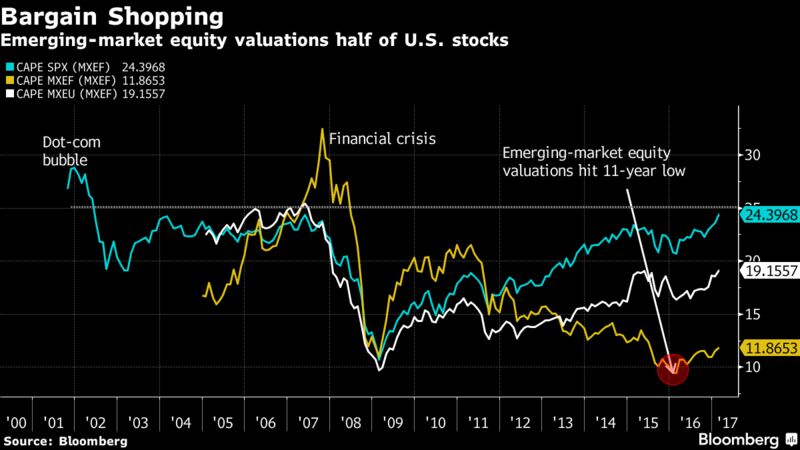
"The investor who called emerging markets the “trade of a decade” before their rally last year sees further gains to come. Christopher Brightman, the chief investment officer at Research Affiliates, says that while emerging equities cost more now than when he first made the call in February 2016, they remain "an enormous bargain." He cited their valuations relative to U.S. stocks, which by his preferred measure are the most expensive since the dot-com bubble of the late 1990s."

For the full article, please click here.


Nile Capital Management
We Know Africa: From Cairo to Cape Town
For more information please call 646-367-2820

Bloomberg- JPMorgan Recommends Overweight ZAR, RUB vs Underweight CEE FX

Bloomberg- JPMorgan Recommends Overweight ZAR, RUB vs Underweight CEE FX

"JPMorgan recommends taking overweight positions in "high yielding" ZAR and RUB vs underweights in CEE currencies... In near term, risk markets will likely overlook valuation hurdles for higher-yielding currencies... 'Potential bounce in metals and oil prices in coming weeks, after a 5%-10% correction since the start of March, should help support these currencies'"


Nile Capital Management
We Know Africa: From Cairo to Cape Town
For more information please call 646-367-2820

September 20, 2016

Bloomberg: Silicon (Valley) Is the Hot New Commodity in Africa

Bloomberg- Silicon (Valley) Is the Hot New Commodity in Africa

"The titans of Silicon Valley are undeterred by the economic slump afflicting much of Africa. Facebook Inc., Google, Oracle Corp. and Uber Technologies Inc. are at the leading edge of turning the world’s frontier markets digital. As the commodity crash buffets the continent’s biggest economies, the interest and investments couldn’t come at a better time. Almost half of foreign direct investment projects in Africa last year were in technology, telecommunications, financial services and consumer products."

For the full article, please click here.


Nile Capital Management
We Know Africa: From Cairo to Cape Town
For more information please call 646-367-2820

August 24, 2016

On South Africa's Rand

South Africa's currency, the Rand, has seen a sharp sell off recently due to reports that the finance minister of South Africa has been notified to appear before the Hawks to face charges. We present the following two charts of the South Africa Rand: first, the Rand from December 2015 when President Zuma removed Finance Minister Nene; and second, the reaction of the Rand to the current news.


Back in December, the Rand fell over 9% across two days before Zuma was forced to appoint Gordhan as the Finance Minister to stem the slide, and the Rand then recovered in the next 2 days to just 2.7% down.

The current sell off in the Rand has not yet reached a similar bottom as compared to the December chart, and it can be expected to get worse if President Zuma does not change course. However, President Zuma would face the same pressures, if not more, as in December and a quick recovery is still possible if Finance Minister Gordhan's situation is resolved amicably.


Nile Capital Management
We Know Africa: From Cairo to Cape Town
For more information please call 646-367-2820

July 5, 2016

Why US Investor Michael Milken Is Bullish on Sub-Saharan Africa

AFK Insider- "Human capital is the world’s best investment, which is why Africa — with its youthful demographic — is such an attractive place to invest, said investor and philanthropist Michael Milken."

For the full article, please click here.


Nile Capital Management
We Know Africa: From Cairo to Cape Town
For more information please call 646-367-2820

May 27, 2016

10 Things the IMF Wants You to Know About Africa's Economy

World Economic Forum- "It’s tough for everyone: the world’s growth this year also been revised downward to 3.2%, from 3.4%. Weak recovery to 3.5% next year is expected. But sub-Saharan Africa’s growth is expected to pick up to 4% in 2017, helped by a recovery in commodity prices—but also significantly, timely policy intervention."

For the full article, please click here.


Nile Capital Management
We Know Africa: From Cairo to Cape Town
For more information please call 646-367-2820

April 20, 2016

The Economist: Making Africa Work

The Economist - "...Afro-pessimists should remember two things about commodity busts. They don’t last for ever. And they don’t hurt everyone: 17 African countries with a quarter of the region’s population will show a net benefit from the current one, thanks to cheaper energy. More important, by focusing on the minerals markets it is easy to miss some big trends that are happening above ground—and these are mostly positive."

For the full article, please click here.


Nile Capital Management
We Know Africa: From Cairo to Cape Town
For more information please call 646-367-2820

April 5, 2016

Do You Know How Diversified Africa's Exports Are?

World Economic Forum- Do you know how diversified Africa's exports are?  The World Economic Forum has posted an insightful map showing each country's major export. 

For the full article, please click here.


Nile Capital Management
We Know Africa: From Cairo to Cape Town
For more information please call 646-367-2820

March 9, 2016

Yahoo Finance: Lower Oil and Higher Gold Could be Great for African Investments

Yahoo Finance- "Falling crude prices and the rallying gold market could mean bad news for some but good news for many investors in Africa."

For the full article, please click here.


Nile Capital Management
We Know Africa: From Cairo to Cape Town
For more information please call 646-367-2820